


What is Gastric Bypass Surgery?
Gastric Bypass Surgery via the Roux-en-Y procedure is generally considered to be the best surgical procedure for the treatment of morbid obesity. Weight loss is achieved by reducing the functional portion of the stomach to a pouch one ounce or less in size, and by creating a stoma, a small opening between the stomach and the intestine.
After the gastric bypass procedure, a small size of the stomach pouch causes the patient to have a sensation of fullness after eating only a small portion of food. The small stoma delays stomach emptying, making the sensation of fullness last longer. These are called the Restrictive components of the procedure.
The limb of intestine coming down from the small pouch is called the Roux limb. The limb of intestine coming down from the bypassed portion of the stomach can be called the Biliary or Bypassed limb. The remaining portion of the intestine is called the Common Channel.
Food does not pass down the Bypassed limb, only the Roux limb and the Common Channel. The longer the Bypassed limb, the less the length of intestine actively working to absorb nutrients from the food that is eaten. Digestive juices that normally help absorb nutrients from the food enter the Bypassed limb from the larger portion of the stomach, the liver, and the pancreas, and pass down the Bypassed limb to the Common Channel. These juices do not mix with the food while it is passing down the Roux limb. The longer the Roux limb, the longer the portion of intestine trying to absorb nutrients without the benefit of these digestive juices. Both of these changes result in less absorption of nutrients and contribute to weight loss, and are called the Malabsorptive components of the procedure.
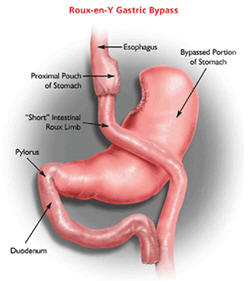
Exactly how the operation is done for an individual patient depends on their individual anatomy, their general health status, whatever changes they may have from prior surgeries, and what they hope to be achieve from the operation. The stoA NEW LIFE...A NEW YOU...Click here to get started now!mach compartments can be completely divided from each other or simply partitioned, the small stomach pouch and the intestinal limbs may be connected to each other with either staples or sutures, a small band may be placed around the stomach pouch, and the two intestinal limbs may be made longer or shorter.
Patients will be on a clear liquid diet for the first few days immediately following gastric bypass surgery, and then advance to a pureed diet. These foods will be very soft, so as to pass through the small, newly formed pouch and stoma. One of the main issues during this period will be adequate fluid intake, and dehydration can be a problem for patients recovering from this surgery. We will ask patients to take in at least 32 ounces of liquid a day before leaving the Gastric Bypass Surgery Center.
Approximately one month after the gastric bypass surgery the patients can expect to advance to a transitional diet. They begin to take more regular table foods, but will often still go back to eating the pureed foods that they have tolerated well. They will still be learning how to eat right, including chewing food carefully, learning to drink most of their liquids between rather than with meals, and learning that eating the wrong foods, such as sweets or fatty foods, can make them ill.
Patients experience the most rapid weight loss during this period. They are often thrilled to see the weight coming off, sometimes at the rate of 20 pounds a month, but it is not an easy time. Patients feel the loss of calories taken in, and are sometimes low in energy. Their small pouch will make them uncomfortable when they eat too much or too fast. They may have diarrhea, which can usually be controlled by avoiding certain foods or by taking medication. They may experience hair loss, though the hair usually begins to grow back within a few months.
At 6 months after the gastric bypass surgery the patients will probably be on their long-term maintenance diet, which is more or less what and how they will eat for the rest of their lives. The maintenance diet for the most part consists of regular table foods, but in small portions. Most patients describe their meals as child sized, and they often do not finish what they are served. The patients generally become comfortable eating these small meals, and almost always say the loss of the ability to enjoy large meals or certain foods is more than compensated for by being able to successfully control their weight.
Patients may expect to lose approximately 70% of their excess body weight during the first 2 years following surgery. Sometimes a weight regain of about 10% is seen between years 2 and 5, perhaps because the small pouch increases several ounces in size, and perhaps because the patients learn how to take in extra calories without making themselves sick.
The surgical community involved in gastric bypass surgery is very concerned about this late 10% or any other weight regain. There is a national effort underway to keep patients involved in support groups and in follow-up with their doctors to reinforce what they had been taught after surgery, and what had worked for them the first 2 years. Long term success with this operation requires a team effort of both the patients and their doctors.
Gastric Bypass Surgery patients take in less food and absorb less of what they take in, making them at risk for developing nutritional deficiencies. They must also make a life long commitment to taking vitamin, mineral, and possibly protein supplements, and may become very ill if they don't. These supplements will cost about $30.00 a month and can be purchased almost anywhere.